
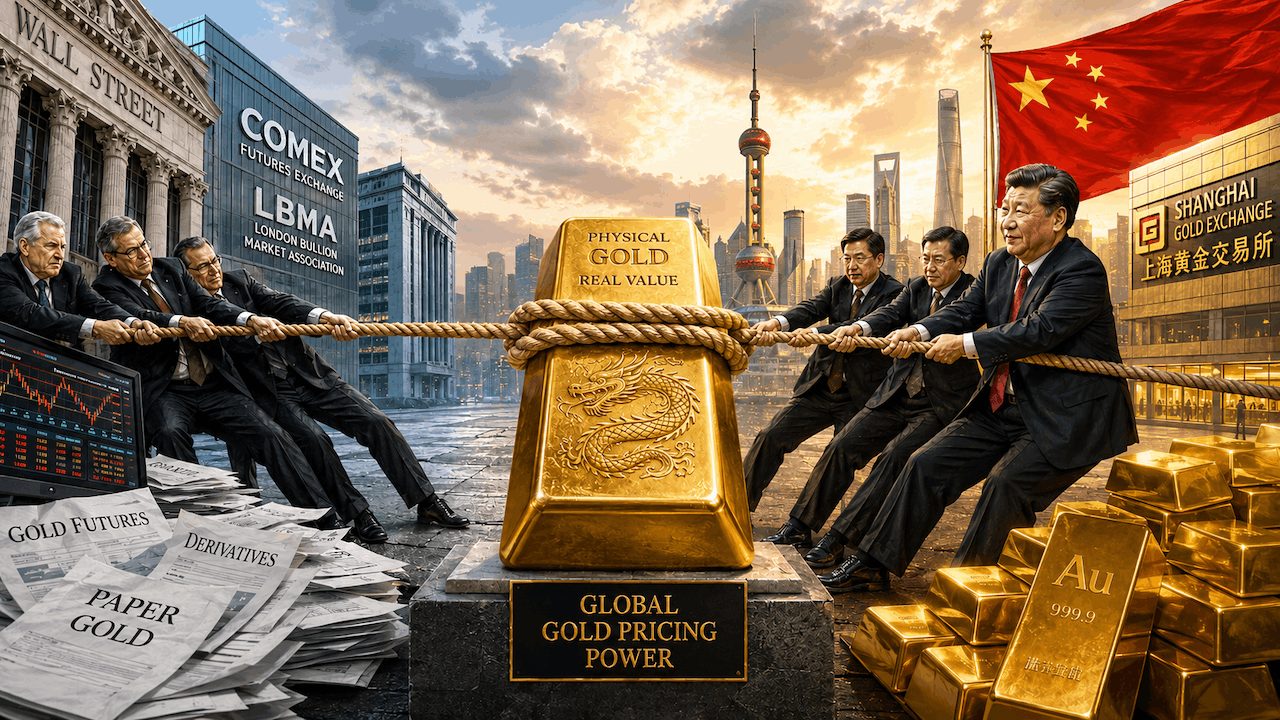
(Mike Maharrey, Money Metals News Service) Several large Chinese banks have announced plans to halt retail paper gold trading. Could this be a coordinated push by China to exert more influence and break the Western grip on gold pricing?
Last month, the Industrial and Commercial Bank of China (ICBC) announced it would stop offering individual trading in precious metals linked to the Shanghai Gold Exchange effective July 24. ICBC ranks as the world’s largest bank by assets.
Postal Savings Bank of China, Ping An Bank, and China Guangfa Bank have also announced plans to end paper gold trading.
Paper trading involves “futures.” These are exchange-traded contracts between two parties who agree to buy/sell a set amount of gold at a predetermined price on a specific future date. At the end of the contract, the buyer can either roll the contract over into a new one or take delivery of the physical metal.
Futures are used for hedging against price fluctuations and for speculating on market movements.
Since most futures traders never take delivery of physical gold, there is far more paper than metal. If every investor holding a buy contract demanded delivery, there wouldn’t be enough gold to go around. This opens the door to price manipulation through the movement of paper contracts.
True Price Discovery
There is some speculation that the sudden exodus of Chinese banks from futures trading, coupled with the new Hong Kong-based gold clearing and settlement system, is a concerted effort by China to have a stronger hand in global gold pricing.
This would represent a seismic shift in the gold market, moving the balance of pricing power away from the paper-dominated West to the physical metal-oriented East.
London, New York, and Switzerland have served as the center of the gold trade for nearly two centuries. The spot price is driven by the London Bullion Market Association (LBMA) morning and evening gold fixes.
Meanwhile, the Shanghai Gold Exchange (SGE) is the world’s largest physical spot gold exchange. Its activity centers on the physical delivery of bullion, unlike the COMEX, which is primarily a hub for moving paper. However, despite its size, the SGE has far less influence on global pricing.
The World Gold Council picked up on an interesting trend in its H1 gold market analysis.
“Interestingly, intraday analysis suggests that the bulk of gold’s movements have been linked to activity during Asian and U.S. trading hours. Many of the pullbacks occurred during U.S. hours and, conversely, gold’s rebounds generally occurred during Asian hours.”
During Asian trading hours, gold was up 12.9 percent through the first six months of the year. During North American trading hours, the yellow metal was down 15 percent. European sessions split the difference, with gold falling modestly by 1.3 percent.
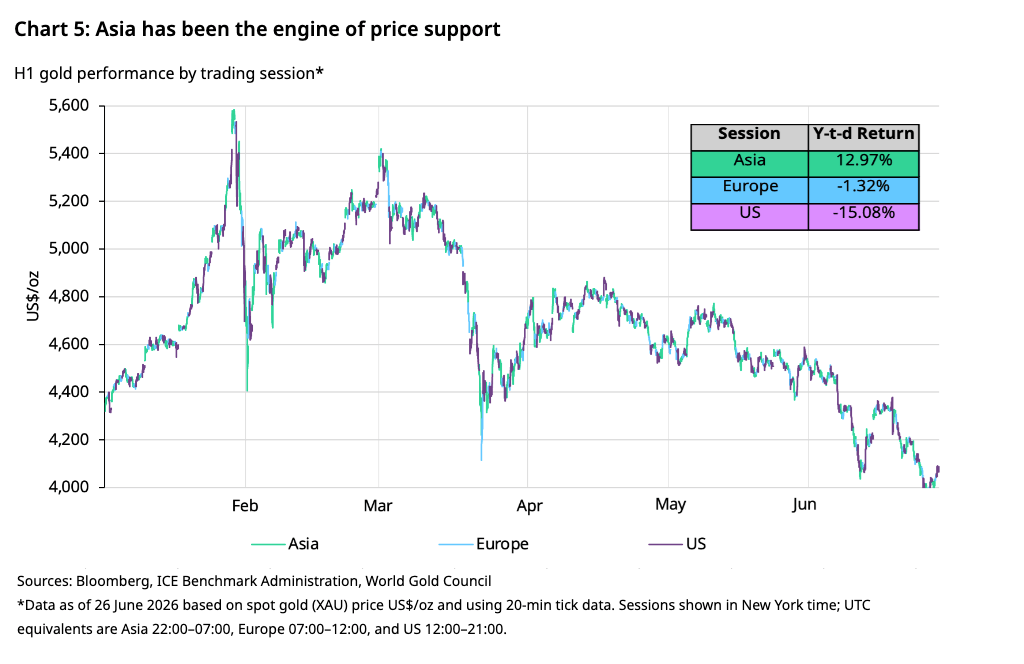
This isn’t just a recent trend. We find that the gold price in Asian markets has typically outperformed the Western gold price for decades.
Analyst Ed Steer argues that this reflects Western price manipulation through the paper markets.
“This simple difference in investment strategy is all the proof needed that the world’s banks and large commercial traders are actively managing the price between the a.m. and p.m. gold fixes in London — and have been doing so since the paper market in gold first opened on 02 January 1975.”
It’s not a leap to think that the Chinese would prefer to set the gold price and strip power away from the paper traders in the West.
Risk Management
Officials say Chinese banks are exiting paper futures trading to manage risk and prevent “speculative excesses.”
“Chinese banks are tightening retail precious metals trading as a risk-control response to heightened price volatility,” State Street Investment Management gold strategist Robin Tsui told the South China Morning Post.
Joshua Rotbart operates a precious metals firm with offices in Hong Kong and Singapore. He agreed, telling the Investing News Network that we shouldn’t take the move as a sign that China is “cooling on gold.”
“What is being switched off is the speculative paper layer. This move reflects a distinction between leveraged paper trading and physical ownership.”
Paper trading increases volatility because it can be moved so easily. Rotbart said Chinese banks have become increasingly concerned about leveraged retail products given the recent price swings.
“When gold prices move sharply, leveraged paper products expose both the investor and the institution to greater risk. Discontinuing these products reduces operational and reputational risk while supporting broader financial stability.”
It also shifts the pricing emphasis away from speculative paper toward the physical market. This would arguably mean a price better reflecting the market fundamentals as opposed to speculative soothsaying.
Rotbart hinted that a more Asian-centric gold pricing regime could orient the market more toward physical gold.
“Over time, this development may encourage greater emphasis on physical ownership rather than short-term leveraged speculation. It channels demand toward the metal itself rather than reducing it.”
VRIC Media CEO Jay Martin said he doesn’t buy the official explanation.
“I think that July 24th is the day that China starts finding out what gold is actually worth.”
He pointed out that the paper market creates the illusion that there is far more gold than there really is, making it easy for paper traders to depress prices.
“If there are 10 paper claims for every real ounce of gold, the market sees 10 times more gold than actually exists.”
By removing this dynamic from the market, Martin argues we will find out “the real price of gold.”
And he thinks it’s much higher than the LBMA fix indicates.
Von Greyerz’s partner Matthew Piepenburg agrees.
“I’ve written ad nauseam for years about the COMEX and the LBMA markets, and how they legalize price manipulation and fraud legally, and China isn’t stupid. They’ve been watching this since 1973 … They know that we use massive amounts of leverage to force the boot to the neck of gold and silver, so we don’t have natural price discovery. Fast forward to 2026, China is saying for us to have more credibility, more trust, and more natural price discovery, we are now going to try and make the paper trade, which is an open secret that it’s a lie; we’re going to call the bluff on that. We’re going to go focus more on physical supply and demand.”
Piepenburg called it “another move in the direction toward true price discovery.”
“What Shanghai and Hong Kong and China in the East are doing is anchoring the trade in something more valuable, actual supply and demand, less nonsense, less dishonesty, and that gives them more credibility.”
It’s impossible to know the true motives of Chinese players in the gold market. However, it doesn’t really matter.
Whether the Chinese government is intentionally trying to wrest control of pricing from the West or simply protecting its investors from volatility and market excess, the practical implications are the same. China is positioning itself to become a more influential player in gold pricing. The Chinese market is much more oriented toward physical bullion.
Ergo, Asian pricing will likely more strongly reflect the value of physical metal as opposed to speculation about gold on paper.
Mike Maharrey is a journalist and market analyst for Money Metals with over a decade of experience in precious metals. He holds a BS in accounting from the University of Kentucky and a BA in journalism from the University of South Florida.


