

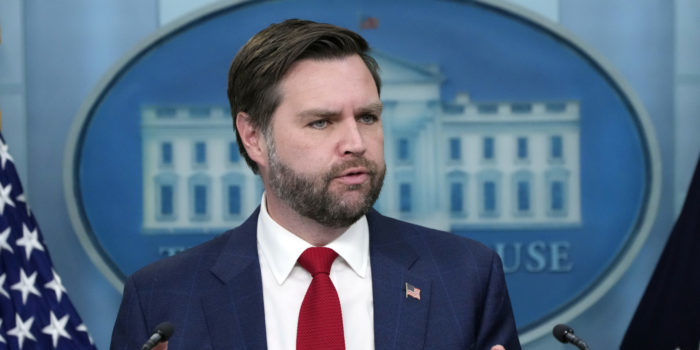
(Dave DeCamp, Antiwar.com) Vice President JD Vance has said that during talks in Switzerland, Iranian officials agreed to establish a direct line of communication between Iran’s Islamic Revolutionary Guard Corps (IRGC) and the US military.
Vance told Sohrab Ahmari, the US editor for UnHerd, that one of the things the US wanted to “come out” of the talks with was a “channel on the Iranian side” for reducing conflict.
“Which we did. They were like, ‘OK, fine, we’ll send somebody from the IRGC to go hang out in Doha with somebody from CENTCOM,’ and that’s how we’re going to settle a lot of these disputes,” the US vice president said during an interview conducted aboard Air Force Two on the flight home from Switzerland.
Flare-ups between the United States and Iran remain possible, as the US hasn’t reduced its forces in the region and there appear to be differences between the two sides’ views on the situation in the Strait of Hormuz. A direct communication channel between the two militaries, if implemented, could help de-escalate tensions after any flare-up to prevent the region from plunging back into full-scale war.
Vance also told Ahmari that Arab states like the US-Iran Memorandum of Understanding “because of the conversations they’re having with the Iranians.”
“The Emiratis — by far the most hawkish, by far the most pro-Israel country in the [Gulf Cooperation Council] — they’re having conversations with the Iranians that have never happened before, including with the IRGC, about various types of economic incentives — ‘Here’s what we’d need to see to make your country investable’ — and the Iranians come back and say, ‘Okay, yeah, we’re willing to do all those things,’” Vance said.
The UAE had taken a much more offensive role in the US-Israeli war against Iran than the other Gulf Arab states, and as a result, it was pounded by Iranian missiles and drones. While more hawkish than other regional countries, Abu Dhabi, like the other Gulf countries, would likely prefer a diplomatic solution to a return to full-scale war since it would likely involve an escalation of Iranian attacks on oil infrastructure in the region.
This article originally appeared at Antiwar.com.


