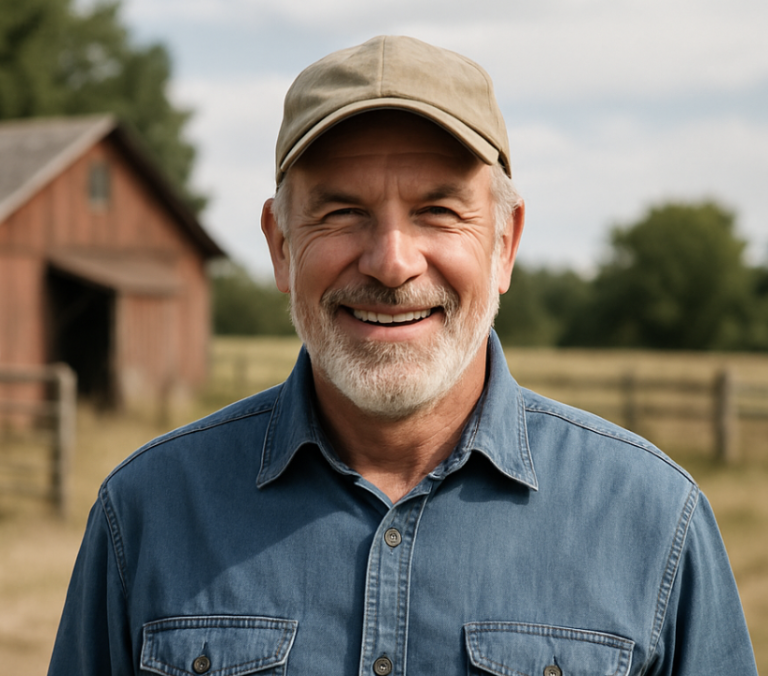
In the rolling prairie just outside Rapid City, South Dakota, you’ll find the home of 47-year-old rancher and prepper, Mark Larson. When his neighbors are planning for the county fair and the high school football game, Mark is planning for something far darker. “We’re not hopeful that it’ll happen,” he told me, “but I’m not going to bet the farm the sun will rise the same tomorrow as it did today.”

A Rancher’s Shift into Survival Mode
Mark’s story starts like many in rural America: cattle, hay, dawn starts and dusk finishes. But five years ago, he began reading articles on nuclear threats, solar-storms, societal collapse and radiation implications. “It hit me one evening,” he recalls, “I realized: if the grid goes down and there’s a blast somewhere, I’m going to fight the dust and the fallout while my neighbors are still scooping up their lawn chairs.”
So he started quietly building:
-
A dedicated “safe room” in his barn with thick concrete walls, sealed door and a hand-powered ventilation system.
-
A stash of potassium iodide tablets and radiation meters, including a DIY Kearny Fallout Meter (which he built himself).
-
A separate off-grid solar panel bank and a deep-cycle battery pack—just enough to run lights, basic communications and water pump if everything else fails.
-
Sealed food barrels, 200 gallons of water in an underground cistern, extra long-life freeze-dried meals and drip irrigation supplies he can run by hand if the pumps fail.
As Mark puts it: “My goal isn’t to survive in luxury—it’s just to make sure I’m still standing when everyone else is still asking, ‘Did the power come back yet?’”
“People Think I’m Crazy. Until The Sirens Go Off.”
Walking around his property, you’ll see a few raised eyebrows from the neighbors. One recently asked him: “Why build a safe room when the biggest threat around here is a hail storm?” Mark chuckles: “Good question. I just tell folks: storms come and go. A blast doesn’t.”
He adds, quietly, “In ’80s they told us we’d outrun tornadoes. I’d rather outrun nothing by being ready for everything.” He also notes: “I don’t think I’ll ever need the bunker—but if I don’t build it, it’s zero chance I’ll be ready.”
The Fallout Game Plan
Mark’s strategy for a nuclear event is methodical:
-
Immediate shelter-in-place: If there’s a flash or alert, he heads into his safe room, shuts off ventilation, switches to filtered-air mode and monitors his homemade fallout meter.
-
Stay locked down for 48-72 hours: “That’s when most of the dangerous stuff falls out,” he points out. “After that, if you’re outside, you’re a rolling target.”
-
Move to secondary shelter if needed: He’s mapped out a nearby limestone cave he discovered on his property. Not the fanciest option—but nature’s concrete. He keeps backpacks pre-loaded with sleeping gear, meals and comms gear.
-
Communication & recon: He has a battery-operated shortwave radio (which you mentioned in your plan) and hand-held HAM radio gear with set frequencies he and his “buddy network” in South Dakota share. “When the grid’s down, you still need to know what’s going on out there,” Mark says.
-
Sustainable living: Even if the event drags out weeks or months, he’s planted a high-yield potato patch, keeps chickens in a movable coop, and invested in a greenhouse that can run off his solar backup. “Because you don’t just want to survive the blast—you want to live afterward.”
The Psychological Edge
Mark says mental readiness is as important as his gear. He practices drills with his wife and two teenagers: safe room lockdowns, contingency evacuation, even radiation meter readings under stress. “You don’t want the first time you say ‘fallout meter reading’ to be when the sky’s orange,” he insists.
He also notes how it changes you: “Sometimes people think prepping is all gloom. But it’s not. For me it’s about empowerment: knowing I’m not helpless. Because when everything collapses, most will panic. I just hope I’m steady.”

Why South Dakota?
Mark chose this location intentionally. He says: “It’s far enough from major targets, with open land and friendly neighbors. But more importantly—community matters. If I’m alone, I lose. If we’re a few families prepared together, that changes things.”
He and two nearby ranching families have formed a loose pact: share resources, check on each other, rotate drills. “We call ourselves the Prairie Watch,” he says with a grin. “When the sirens go off, we don’t ask ‘why’—we just act.”
Final Word
So what’s the takeaway from Mark’s story? It’s this: You don’t need a bunker the size of a shopping mall or a six-figure budget to be serious. You just need a plan, a few tools, and the mindset to act. Mark’s not waiting for permission or hoping someone else will fix things. He’s doing something now—while he still can.
As he puts it:
“When the sky turns orange and the world changes in a few heartbeats, I’d rather be ready than be the one asking, ‘What do we do now?’”